
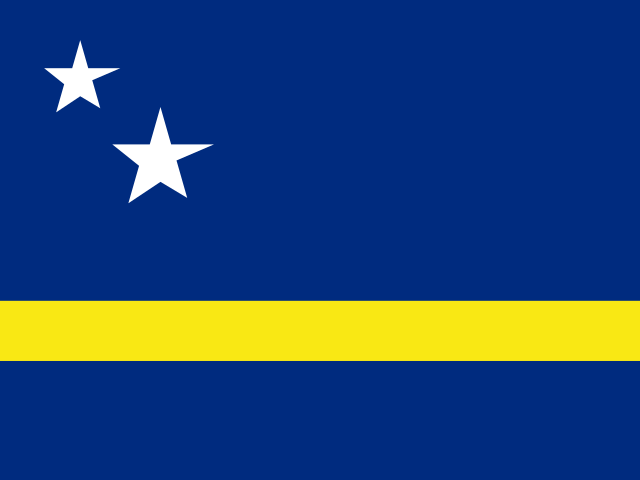
Curaçao
Curaçao is a dry, low-lying island in the southern Caribbean, part of the Dutch Caribbean and one of the ABC islands. Its landscape is characterised by limestone hills, thorny scrub, dry woodland, cactus-covered terrain and sheltered coastal bays rather than lush tropical rainforest. Christoffel National Park contains the island's highest point, Christoffelberg, while the northern coast is more rugged, with limestone cliffs and wave-cut inlets. Salt pans and shallow coastal wetlands are scattered across the island, providing important habitat despite the generally arid conditions. Curaçao lies outside the main Caribbean hurricane belt, contributing to its relatively reliable year-round climate. Its combination of dry Caribbean vegetation, rugged coastline and well-developed infrastructure gives it a distinctly different character from the wetter, mountainous islands farther north and east.
Overview
Curaçao is best for dry-country Caribbean birds, flamingos and migrants, rather than sheer species diversity. More than 168 species have been recorded, including North American migrants, South American visitors and resident Caribbean species. The colourful Curaçao Troupial and Brown-throated Parakeet are characteristic island birds, while Caribbean Flamingos regularly gather at salt pans such as Jan Kok and the wetlands around Sint Willibrordus. Christoffel National Park provides the main terrestrial birding habitat, with dry forest and scrub supporting a variety of resident species. Curaçao is particularly convenient for independent birding: the island is compact, roads are generally good and most sites can be reached by rental car. Early mornings are preferable because of the heat, especially when exploring exposed dry habitats.
Top 10 target species
| Species | Annual frequency | January | February | March | April | May | June | July | August | September | October | November | December |
|---|---|---|---|---|---|---|---|---|---|---|---|---|---|
| Tropical Mockingbird Mimus gilvus | 71.8% | 71.5% | 69.4% | 69.2% | 75.2% | 71.3% | 71.6% | 75.7% | 73.3% | 73.4% | 70.1% | 69.3% | 71.8% |
| Bananaquit Coereba flaveola | 61.9% | 61.1% | 59.5% | 58.9% | 67.6% | 62.1% | 62.3% | 68.4% | 64.2% | 63.3% | 61.5% | 56.2% | 57.4% |
| Venezuelan Troupial Icterus icterus | 61.5% | 61.2% | 63.3% | 53.5% | 64.7% | 61.1% | 64.0% | 70.7% | 67.9% | 64.8% | 52.9% | 52.8% | 60.7% |
| Brown-throated Parakeet Eupsittula pertinax | 60.8% | 57.0% | 58.2% | 58.7% | 64.1% | 61.1% | 59.8% | 67.4% | 62.2% | 62.8% | 61.9% | 57.9% | 59.0% |
| Bare-eyed Pigeon Patagioenas corensis | 59.5% | 59.1% | 59.7% | 54.0% | 60.6% | 61.5% | 61.2% | 67.5% | 63.8% | 65.0% | 56.1% | 48.4% | 56.5% |
| Common Ground Dove Columbina passerina | 48.9% | 44.4% | 45.3% | 37.7% | 47.2% | 51.3% | 55.4% | 57.8% | 54.0% | 55.8% | 50.1% | 42.5% | 45.3% |
| White-tipped Dove Leptotila verreauxi | 40.7% | 35.0% | 37.5% | 33.4% | 44.2% | 39.6% | 40.3% | 44.7% | 43.7% | 49.2% | 48.8% | 36.9% | 35.3% |
| Eared Dove Zenaida auriculata | 39.5% | 34.8% | 33.4% | 31.9% | 39.2% | 46.4% | 38.0% | 48.1% | 47.4% | 48.3% | 41.2% | 29.9% | 35.3% |
| Crested Caracara Caracara plancus | 38.4% | 37.4% | 39.6% | 37.2% | 40.8% | 37.0% | 39.2% | 40.2% | 38.1% | 40.5% | 38.1% | 33.0% | 39.7% |
| Black-faced Grassquit Melanospiza bicolor | 38.0% | 31.2% | 31.1% | 28.6% | 39.0% | 41.5% | 38.6% | 43.8% | 45.8% | 45.4% | 43.1% | 33.4% | 34.8% |