
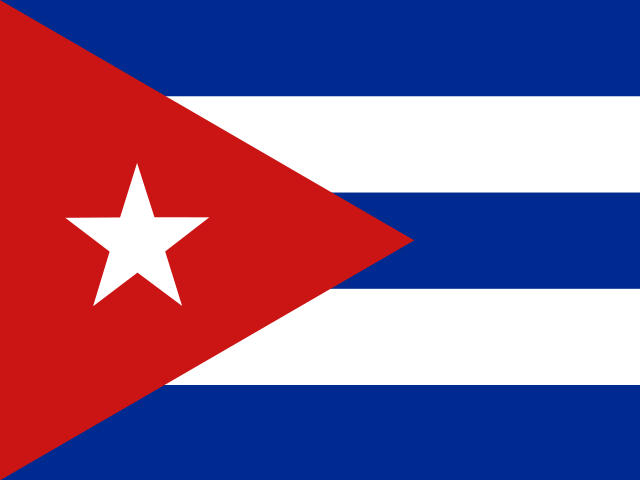
Cuba
Cuba is the largest island in the Caribbean, stretching east–west with a landscape of low mountains, limestone hills, fertile plains and extensive coastal wetlands. The Sierra Maestra in the southeast contains the country's highest peaks and more rugged terrain, while the Zapata Peninsula is dominated by swamps, mangroves and seasonally flooded forests. Dry forests and scrub are more characteristic of parts of the east, while agricultural landscapes occupy much of the central and western lowlands. Cuba's tropical climate is moderated by surrounding seas, with a pronounced wet season and a drier winter period. Its long isolation from mainland North America and South America has produced a distinctive island environment with a notable number of endemic species.
Overview
Cuba is one of the Caribbean's most interesting destinations for endemic birds, with the Zapata Swamp being the country's most important birding region. It supports species including Cuban Tody, Cuban Green Woodpecker, Fernandina's Flicker and the critically endangered Zapata Wren and Zapata Sparrow. The tiny Bee Hummingbird, endemic to Cuba and the world's smallest bird, is another major target. The Sierra Maestra and eastern mountains add species such as Cuban Solitaire and Cuban Trogon, the national bird. Cuba also receives substantial numbers of North American migrants during winter. Zapata National Park and several private or guided birding operations make targeted endemic-focused trips practical, although some of the best sites are remote and local guides are particularly useful.
Top 10 target species
| Species | Annual frequency | January | February | March | April | May | June | July | August | September | October | November | December |
|---|---|---|---|---|---|---|---|---|---|---|---|---|---|
| Turkey Vulture Cathartes aura | 54.0% | 56.0% | 55.5% | 53.4% | 54.6% | 54.9% | 51.6% | 56.5% | 54.2% | 53.4% | 51.7% | 52.9% | 53.4% |
| Northern Mockingbird Mimus polyglottos | 46.1% | 43.3% | 43.4% | 42.9% | 45.2% | 51.1% | 54.6% | 48.5% | 42.7% | 48.3% | 49.4% | 41.5% | 43.0% |
| Cuban Emerald Riccordia ricordii | 41.5% | 37.5% | 37.3% | 37.1% | 37.6% | 44.4% | 45.8% | 46.3% | 46.4% | 48.7% | 43.5% | 35.9% | 37.6% |
| Cuban Blackbird Ptiloxena atroviolacea | 39.2% | 34.2% | 33.7% | 31.0% | 35.2% | 45.6% | 46.0% | 45.5% | 42.0% | 45.5% | 41.8% | 35.1% | 35.4% |
| Common Ground Dove Columbina passerina | 35.6% | 26.8% | 25.1% | 27.0% | 31.5% | 42.0% | 45.4% | 46.3% | 48.2% | 45.1% | 37.9% | 25.5% | 26.4% |
| Mourning Dove Zenaida macroura | 35.5% | 25.0% | 28.3% | 31.0% | 35.5% | 46.7% | 46.9% | 51.2% | 46.3% | 40.0% | 30.7% | 21.9% | 22.5% |
| Western Red-legged Thrush Turdus plumbeus | 33.3% | 29.9% | 32.3% | 34.4% | 38.8% | 42.7% | 40.6% | 33.5% | 27.7% | 32.3% | 29.8% | 26.9% | 30.8% |
| Greater Antillean Grackle Quiscalus niger | 32.9% | 28.0% | 35.5% | 40.0% | 41.9% | 40.1% | 38.0% | 36.3% | 29.1% | 24.4% | 23.0% | 29.4% | 29.0% |
| House Sparrow Passer domesticus | 32.5% | 24.6% | 22.5% | 22.6% | 28.6% | 44.3% | 47.3% | 44.8% | 42.3% | 37.5% | 29.6% | 21.7% | 23.9% |
| Gray Kingbird Tyrannus dominicensis | 27.5% | 0.2% | 0.2% | 12.7% | 46.2% | 58.5% | 60.5% | 59.5% | 55.5% | 30.1% | 5.8% | 0.7% | 0.4% |