
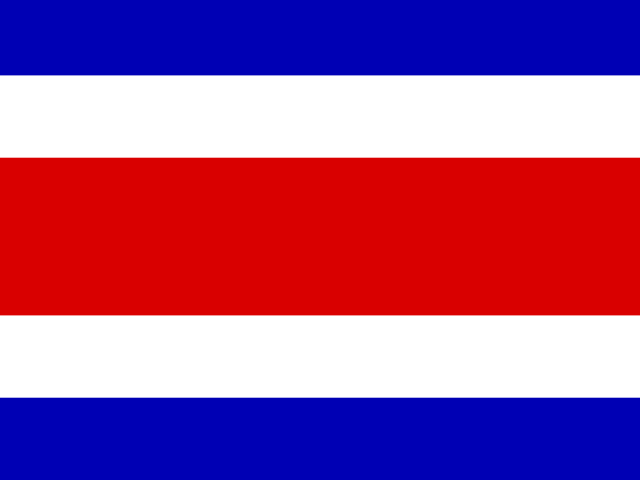
Costa Rica
Costa Rica sits between Nicaragua and Panama, with the Pacific Ocean and Caribbean Sea separated by a mountainous interior. Despite its modest size, the country contains striking environmental contrasts, from dry tropical forest in the northwest to humid lowland rainforest and cool cloud forests in the central mountains. The Cordillera de Talamanca forms the country's highest terrain, while volcanic ranges dominate much of the interior. Pacific and Caribbean lowlands have distinct rainfall patterns, creating different ecosystems on opposite sides of the mountains. Costa Rica has retained extensive forest cover through a large network of national parks and protected areas, alongside a landscape of farms, plantations and smaller forest fragments. This combination of varied elevation, tropical climate and protected habitat is one of the defining characteristics of the country.
Overview
Costa Rica is one of the world's best-known destinations for tropical birding, combining exceptional diversity with unusually well-developed birding infrastructure. The country is particularly strong for hummingbirds, tanagers, trogons and toucans, with Resplendent Quetzal a major attraction in the highlands of the Talamanca range. Monteverde is famous for cloud-forest birds, while Carara National Park provides an important transition between dry and humid forest and is notable for Scarlet Macaw. The Caribbean lowlands around La Selva offer exceptionally rich rainforest birding, while the Osa Peninsula contains extensive lowland forest and a distinctive southern Pacific avifauna. Well-established lodges, reserves and birding guides make Costa Rica particularly accessible for visitors, and its compact geography allows several major habitats to be combined within a relatively short trip.
Top 10 target species
| Species | Annual frequency | January | February | March | April | May | June | July | August | September | October | November | December |
|---|---|---|---|---|---|---|---|---|---|---|---|---|---|
| Clay-colored Thrush Turdus grayi | 40.4% | 36.6% | 38.7% | 43.7% | 50.2% | 51.8% | 47.3% | 37.5% | 34.1% | 36.2% | 38.8% | 35.0% | 34.6% |
| Great Kiskadee Pitangus sulphuratus | 39.6% | 38.4% | 39.0% | 39.0% | 39.2% | 40.0% | 41.1% | 39.3% | 39.6% | 40.5% | 41.3% | 39.1% | 38.2% |
| Black Vulture Coragyps atratus | 36.3% | 39.6% | 38.8% | 38.1% | 35.6% | 32.4% | 31.3% | 33.3% | 34.8% | 37.8% | 37.9% | 36.8% | 39.1% |
| Tropical Kingbird Tyrannus melancholicus | 34.9% | 35.2% | 33.1% | 32.5% | 32.1% | 33.4% | 35.3% | 34.4% | 34.7% | 36.3% | 38.1% | 37.3% | 36.6% |
| Blue-gray Tanager Thraupis episcopus | 34.1% | 30.8% | 32.1% | 34.5% | 36.9% | 36.9% | 36.1% | 33.2% | 34.3% | 36.3% | 36.0% | 31.9% | 30.1% |
| Rufous-tailed Hummingbird Amazilia tzacatl | 32.6% | 31.1% | 29.5% | 29.0% | 30.8% | 32.1% | 32.8% | 31.8% | 32.7% | 36.1% | 37.8% | 34.6% | 33.1% |
| Turkey Vulture Cathartes aura | 29.0% | 33.1% | 32.8% | 32.8% | 29.1% | 25.4% | 24.5% | 25.4% | 25.7% | 27.3% | 29.0% | 30.0% | 32.6% |
| Great-tailed Grackle Quiscalus mexicanus | 27.5% | 28.2% | 27.6% | 28.1% | 29.4% | 30.1% | 31.2% | 27.1% | 24.9% | 23.7% | 24.6% | 27.5% | 27.2% |
| Social Flycatcher Myiozetetes similis | 26.3% | 24.5% | 24.6% | 26.4% | 26.7% | 27.9% | 27.9% | 25.5% | 25.4% | 27.7% | 28.8% | 25.6% | 24.5% |
| Scarlet-rumped Tanager Ramphocelus passerinii | 25.9% | 24.9% | 26.3% | 27.7% | 27.9% | 27.7% | 25.8% | 25.0% | 24.7% | 24.5% | 26.2% | 24.5% | 25.4% |