
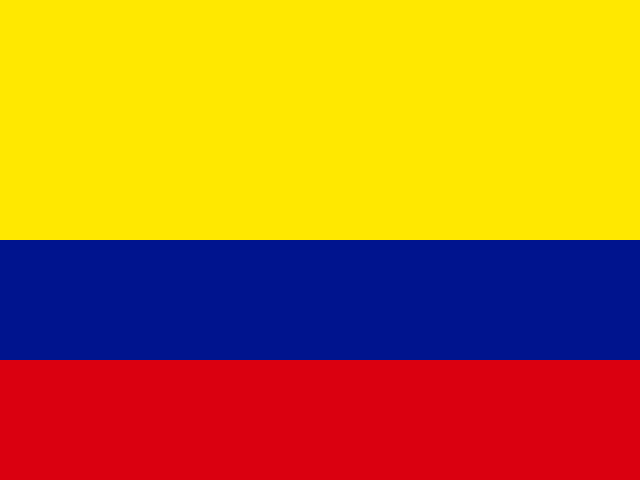
Colombia
Colombia sits at the meeting point of the Andes, Caribbean, Pacific, Amazon and Orinoco regions, giving it an extraordinary range of landscapes within a relatively compact area. The Andes split into three major cordilleras, creating deep inter-Andean valleys, high páramos and extensive cloud forests. To the west, the Chocó is one of the wettest tropical regions on Earth, while the eastern plains gradually merge into Amazonian rainforest. The Caribbean coast includes dry forests and coastal wetlands, and the isolated Sierra Nevada de Santa Marta rises directly from the Caribbean to more than 5,700 metres. This combination of altitude, latitude and geography produces strong regional differences in climate and vegetation, with almost every major Neotropical habitat represented.
Overview
Colombia is the world's most bird-diverse country, with more than 1,900 recorded species and an exceptional concentration of endemics. Its greatest strength is the sheer variety of habitats: Andean cloud forests, páramos, Chocó rainforest, Amazonian forest, Caribbean dry forest and eastern plains can all produce very different species. The Sierra Nevada de Santa Marta is particularly extraordinary, with numerous range-restricted species including Santa Marta Parakeet, Santa Marta Antpitta and Santa Marta Mountain-Tanager. Other major destinations include the Coffee Region, Bogotá's surrounding mountains, the Colombian Pacific and Amazonian areas around Leticia. Colombia has a well-developed birding tourism industry, with numerous reserves, lodges and specialist guides, making many otherwise challenging habitats accessible. Its year-round birding and enormous regional variation make it particularly rewarding for multiple visits.
Top 10 target species
| Species | Annual frequency | January | February | March | April | May | June | July | August | September | October | November | December |
|---|---|---|---|---|---|---|---|---|---|---|---|---|---|
| Tropical Kingbird Tyrannus melancholicus | 38.4% | 36.8% | 35.7% | 36.5% | 40.4% | 41.2% | 41.6% | 40.4% | 38.9% | 38.4% | 38.3% | 35.5% | 36.9% |
| Blue-gray Tanager Thraupis episcopus | 35.6% | 35.4% | 35.0% | 36.1% | 38.6% | 38.5% | 37.2% | 35.1% | 34.0% | 33.9% | 35.8% | 33.4% | 34.1% |
| Black Vulture Coragyps atratus | 34.9% | 35.9% | 35.1% | 34.8% | 34.1% | 34.4% | 34.1% | 35.2% | 34.9% | 35.5% | 35.3% | 34.9% | 34.7% |
| Southern House Wren Troglodytes musculus | 28.0% | 26.0% | 25.3% | 26.1% | 28.9% | 30.1% | 30.0% | 28.2% | 28.2% | 29.1% | 30.3% | 26.9% | 27.0% |
| Great Kiskadee Pitangus sulphuratus | 26.3% | 26.3% | 26.0% | 26.1% | 28.5% | 28.8% | 27.9% | 25.6% | 24.7% | 24.4% | 26.4% | 24.5% | 25.8% |
| Palm Tanager Thraupis palmarum | 24.3% | 24.8% | 24.0% | 24.7% | 25.9% | 25.5% | 25.0% | 23.7% | 23.3% | 23.2% | 24.6% | 23.8% | 23.6% |
| Rufous-collared Sparrow Zonotrichia capensis | 23.9% | 22.5% | 22.9% | 23.1% | 24.7% | 24.7% | 25.5% | 24.5% | 24.3% | 24.4% | 23.7% | 23.8% | 22.7% |
| Roadside Hawk Rupornis magnirostris | 21.2% | 21.0% | 19.6% | 19.7% | 20.6% | 21.9% | 21.4% | 20.4% | 20.9% | 21.7% | 23.3% | 21.8% | 21.9% |
| Saffron Finch Sicalis flaveola | 21.1% | 19.2% | 18.3% | 19.4% | 23.6% | 25.0% | 24.8% | 23.1% | 20.9% | 19.8% | 21.2% | 19.1% | 18.8% |
| Ruddy Ground Dove Columbina talpacoti | 21.0% | 20.3% | 19.3% | 19.5% | 21.5% | 22.6% | 22.6% | 22.0% | 20.8% | 20.9% | 22.3% | 20.3% | 20.4% |