
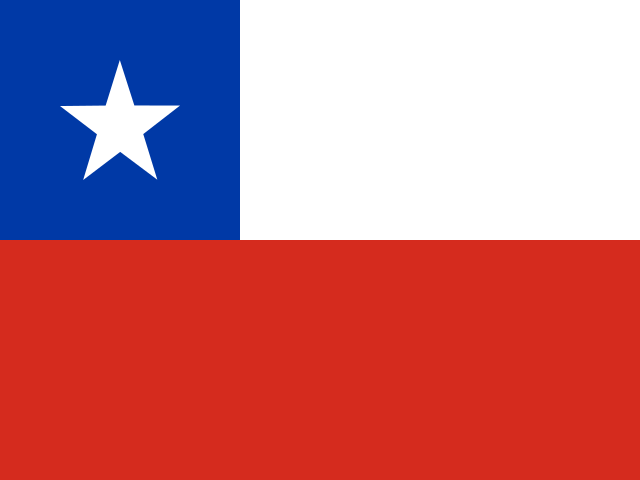
Chile
Chile is defined by its extraordinary north–south extent, stretching from the Atacama Desert to the fjords and sub-Antarctic landscapes of Patagonia. The Andes form its eastern backbone, while the Pacific Ocean strongly influences the climate along the country's narrow western side. The north is one of the driest places on Earth, but high-altitude altiplano wetlands and salt flats create striking oases of life. Central Chile has a Mediterranean climate, while the south becomes progressively wetter, with temperate rainforest, glaciers, fjords and thousands of islands. Chiloé, Tierra del Fuego and the Aysén region have particularly distinctive landscapes shaped by the sea and mountains. Offshore, the Juan Fernández Archipelago is notable for its high level of endemism. This exceptional environmental gradient is one of Chile's defining characteristics.
Overview
Chile is particularly rewarding for birders interested in distinctive southern South American birds, desert species and high-Andean wetlands. The north around Arica and the Altiplano is excellent for high-altitude species and migratory birds; Lluta River estuary regularly holds large numbers of shorebirds. At the Atacama salt flats, Chilean, Andean and James's Flamingos can occur together. Central Chile offers species such as Chilean Tinamou and Chilean Flicker, while the temperate forests of the south are particularly good for Chucao Tapaculo and Magellanic birds. Tierra del Fuego is important for the rare Magellanic Plover, and Patagonia provides excellent opportunities for Andean Condor and seabirds. Chile has good infrastructure for independent travel, although reaching the far north, Patagonia and remote islands requires substantial travel.
Top 10 target species
| Species | Annual frequency | January | February | March | April | May | June | July | August | September | October | November | December |
|---|---|---|---|---|---|---|---|---|---|---|---|---|---|
| Austral Thrush Turdus falcklandii | 40.1% | 38.7% | 30.3% | 29.3% | 35.4% | 39.7% | 47.0% | 46.6% | 48.5% | 46.3% | 40.4% | 38.2% | 40.6% |
| Chimango Caracara Daptrius chimango | 39.1% | 33.2% | 34.3% | 37.4% | 42.9% | 43.4% | 43.2% | 43.0% | 43.9% | 42.3% | 37.7% | 33.8% | 34.4% |
| Rufous-collared Sparrow Zonotrichia capensis | 37.8% | 32.4% | 24.6% | 27.0% | 30.6% | 32.9% | 36.0% | 38.0% | 44.4% | 50.4% | 48.8% | 46.7% | 41.3% |
| Southern Lapwing Vanellus chilensis | 34.2% | 32.0% | 33.5% | 31.2% | 31.0% | 33.8% | 34.1% | 37.4% | 38.3% | 40.1% | 36.1% | 31.7% | 31.7% |
| Southern House Wren Troglodytes musculus | 31.3% | 23.8% | 25.0% | 30.3% | 34.5% | 31.7% | 28.3% | 29.6% | 35.1% | 38.9% | 37.3% | 32.0% | 29.1% |
| Kelp Gull Larus dominicanus | 30.6% | 32.8% | 33.2% | 29.4% | 25.9% | 28.0% | 30.8% | 34.7% | 31.1% | 31.2% | 30.8% | 29.6% | 29.5% |
| Chilean Swallow Tachycineta leucopyga | 24.2% | 29.8% | 22.6% | 13.2% | 12.7% | 15.9% | 16.3% | 19.2% | 24.8% | 34.0% | 35.4% | 32.9% | 32.9% |
| Eared Dove Zenaida auriculata | 24.1% | 21.8% | 19.5% | 21.6% | 22.9% | 23.1% | 26.2% | 26.1% | 28.8% | 29.2% | 25.4% | 22.4% | 22.3% |
| House Sparrow Passer domesticus | 24.1% | 24.1% | 17.7% | 17.7% | 23.3% | 23.3% | 24.5% | 25.0% | 28.0% | 28.4% | 26.4% | 24.7% | 25.4% |
| Green-backed Firecrown Sephanoides sephaniodes | 23.9% | 7.6% | 15.5% | 25.9% | 39.2% | 39.4% | 38.5% | 35.7% | 35.1% | 23.3% | 11.8% | 7.2% | 7.2% |