
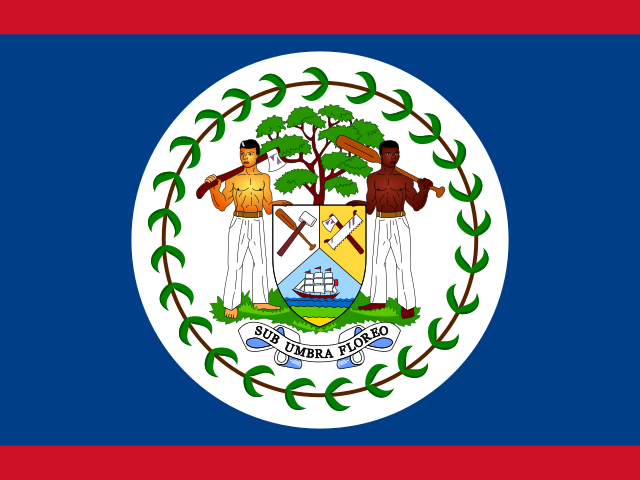
Belize
Belize is a small Central American country on the Caribbean coast, with a landscape that shifts from coastal mangroves, lagoons and barrier reefs to tropical forest and the Maya Mountains inland. The Belize Barrier Reef and offshore cayes are a defining geographical feature, while inland rivers and wetlands connect the coast with broad areas of forest. The Maya Mountains rise sharply from the surrounding lowlands, with Mountain Pine Ridge providing a striking contrast to the predominantly tropical vegetation. Much of the country retains relatively extensive natural habitat, and protected areas cover a significant part of its land and marine environments. Belize also has a distinctly Caribbean character alongside its Central American geography, reflected in its English-speaking heritage and cultural mix.
Overview
Belize is an excellent destination for accessible tropical birding, with a particularly useful combination of rainforest, wetlands, pine woodland and Caribbean habitats. Crooked Tree Wildlife Sanctuary is one of the country's best-known birding sites, especially for waterbirds and Jabiru, while Cockscomb Basin Wildlife Sanctuary provides extensive forest habitat and growing birdwatching tourism. Mountain Pine Ridge adds species associated with pine and upland habitats, including the uncommon Orange-breasted Falcon. Belize is also strong for toucans, parrots, trogons and other tropical forest birds, with the Keel-billed Toucan among its characteristic species. Established reserves, guides and nature lodges make the country relatively straightforward for visiting birders, and its compact size allows several major habitats to be combined in one trip.
Top 10 target species
| Species | Annual frequency | January | February | March | April | May | June | July | August | September | October | November | December |
|---|---|---|---|---|---|---|---|---|---|---|---|---|---|
| Social Flycatcher Myiozetetes similis | 37.9% | 32.2% | 33.6% | 38.5% | 40.8% | 41.1% | 42.4% | 39.0% | 38.6% | 39.2% | 38.4% | 36.1% | 35.5% |
| Melodious Blackbird Dives dives | 36.2% | 32.9% | 31.6% | 33.6% | 38.1% | 39.9% | 41.4% | 38.0% | 38.4% | 35.3% | 34.7% | 35.8% | 34.6% |
| Great-tailed Grackle Quiscalus mexicanus | 34.4% | 32.5% | 33.2% | 37.8% | 38.2% | 36.6% | 36.1% | 31.8% | 33.0% | 30.7% | 31.9% | 35.9% | 34.6% |
| Great Kiskadee Pitangus sulphuratus | 34.1% | 30.6% | 30.9% | 33.4% | 34.5% | 34.8% | 35.5% | 33.4% | 36.0% | 35.8% | 35.5% | 35.1% | 33.8% |
| Morelet's Seedeater Sporophila morelleti | 31.6% | 25.8% | 28.6% | 28.4% | 31.0% | 32.6% | 36.4% | 40.2% | 42.7% | 27.9% | 23.8% | 32.1% | 29.5% |
| Rufous-tailed Hummingbird Amazilia tzacatl | 30.3% | 29.4% | 29.1% | 30.4% | 30.2% | 31.4% | 32.6% | 30.3% | 30.7% | 30.3% | 28.8% | 30.8% | 29.8% |
| Golden-fronted Woodpecker Melanerpes aurifrons | 29.4% | 25.4% | 26.4% | 28.4% | 32.5% | 33.4% | 34.1% | 30.7% | 29.3% | 30.1% | 27.5% | 27.6% | 27.2% |
| Clay-colored Thrush Turdus grayi | 27.3% | 22.2% | 24.2% | 26.8% | 30.1% | 36.0% | 39.4% | 37.6% | 31.9% | 20.4% | 17.8% | 20.4% | 20.5% |
| Brown Jay Cyanocorax morio | 27.0% | 27.5% | 26.8% | 28.7% | 31.2% | 28.9% | 25.5% | 22.2% | 23.9% | 26.7% | 26.1% | 27.4% | 29.4% |
| Turkey Vulture Cathartes aura | 25.3% | 25.9% | 26.9% | 27.3% | 25.1% | 24.3% | 23.6% | 22.7% | 25.3% | 23.7% | 24.5% | 26.6% | 27.7% |