
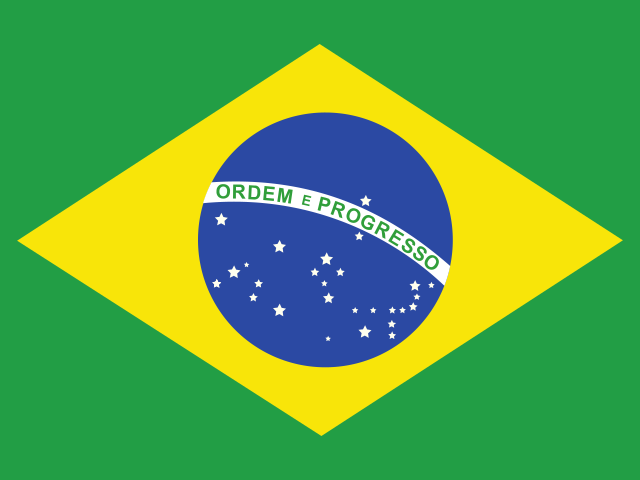
Brazil
Brazil is the largest country in South America and contains an exceptional range of landscapes, from the Amazon rainforest and Cerrado savannas to the Atlantic Forest, Caatinga and Pantanal wetlands. The enormous Amazon basin dominates the north, while the central plateau is characterised by seasonal savannas and gallery forests. Along the Atlantic coast, the fragmented Atlantic Forest contains humid rainforest, mountains and coastal lowlands, while the northeast's Caatinga is a distinctive dry ecosystem found nowhere else. The Pantanal forms one of the world's largest tropical wetlands, flooding seasonally across a vast lowland basin. Brazil's enormous coastline adds mangroves, dunes, estuaries and offshore islands. These major biomes create strong regional contrasts and make Brazil one of the world's most geographically diverse countries.
Overview
Brazil is one of the world's great birding countries, combining huge species diversity with exceptional Atlantic Forest endemism and specialised birds of the Amazon, Cerrado and Pantanal. The Pantanal, particularly around the Transpantaneira north of Cuiabá, is renowned for abundant waterbirds and species such as Hyacinth Macaw, Jabiru and Sunbittern. The Atlantic Forest is especially important for endemic and threatened birds, including tanagers, antbirds, toucans and parrots. Iguaçu National Park offers accessible Atlantic Forest birding alongside its famous waterfalls, while the Amazon around Manaus and Cristalino provides an entirely different tropical community. Brazil's size means that serious birding usually requires focusing on one or two regions rather than attempting to cover the country. Well-developed lodges, guides and wildlife tourism make major destinations accessible, but remote Amazonian areas can involve substantial logistical planning.
Top 10 target species
| Species | Annual frequency | January | February | March | April | May | June | July | August | September | October | November | December |
|---|---|---|---|---|---|---|---|---|---|---|---|---|---|
| Great Kiskadee Pitangus sulphuratus | 54.0% | 54.7% | 54.3% | 55.2% | 56.7% | 56.7% | 54.7% | 52.1% | 52.5% | 51.3% | 52.4% | 52.6% | 54.7% |
| Sayaca Tanager Thraupis sayaca | 35.7% | 36.8% | 33.6% | 34.9% | 35.2% | 34.1% | 31.9% | 30.1% | 33.3% | 37.9% | 40.5% | 39.7% | 40.8% |
| Black Vulture Coragyps atratus | 32.7% | 29.4% | 28.6% | 29.9% | 32.2% | 34.1% | 34.5% | 35.8% | 35.5% | 35.1% | 34.7% | 32.4% | 30.6% |
| Ruddy Ground Dove Columbina talpacoti | 31.8% | 34.2% | 36.2% | 36.0% | 34.3% | 32.4% | 30.0% | 27.8% | 28.7% | 28.5% | 30.2% | 29.9% | 33.0% |
| Picazuro Pigeon Patagioenas picazuro | 31.2% | 30.3% | 30.2% | 30.1% | 31.9% | 33.5% | 32.6% | 32.3% | 32.2% | 31.6% | 31.0% | 28.8% | 30.2% |
| Bananaquit Coereba flaveola | 30.7% | 27.5% | 29.4% | 32.7% | 33.9% | 32.2% | 30.8% | 29.5% | 31.5% | 31.1% | 30.3% | 29.3% | 30.8% |
| Southern House Wren Troglodytes musculus | 30.4% | 28.8% | 28.1% | 29.8% | 31.7% | 28.8% | 25.8% | 27.5% | 31.9% | 33.7% | 35.1% | 32.5% | 31.1% |
| Rufous Hornero Furnarius rufus | 28.7% | 30.5% | 30.2% | 29.6% | 29.5% | 28.8% | 26.7% | 25.8% | 27.4% | 28.1% | 28.6% | 28.3% | 30.8% |
| Saffron Finch Sicalis flaveola | 27.3% | 32.8% | 31.4% | 27.9% | 24.7% | 24.5% | 23.4% | 22.8% | 23.9% | 25.0% | 29.0% | 29.9% | 32.7% |
| Southern Lapwing Vanellus chilensis | 26.8% | 25.6% | 25.5% | 26.1% | 26.9% | 29.5% | 27.2% | 27.2% | 27.4% | 27.4% | 28.3% | 26.2% | 24.9% |