
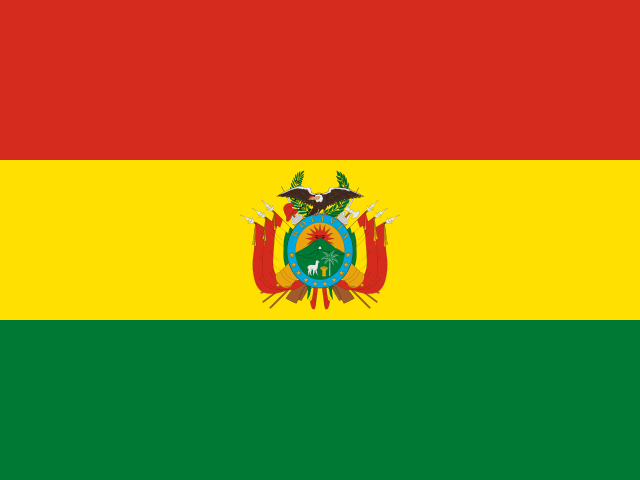
Bolivia
Bolivia is dominated by a dramatic transition from the high Andes to the Amazon basin, with the dry lowlands of the Chaco and the seasonally flooded Beni plains adding further contrasts. The western Andes contain the high Altiplano, snow-capped peaks and deep valleys, while the eastern slopes descend through Yungas cloud forests into humid lowland rainforest. The Beni savannas form an extensive mosaic of grasslands, wetlands and gallery forest that floods extensively during the rainy season. In the southeast, the Gran Chaco is much drier, with thorny woodland and open scrub. This combination of extreme elevation, tropical lowlands and seasonal wetlands gives Bolivia an unusually varied geography despite being landlocked. The transition from the Andes into the Amazon is particularly important, with steep changes in climate and vegetation occurring over relatively short distances.
Overview
Bolivia is one of South America's richest birding countries, particularly strong for Andean, Amazonian and savanna birds. Amboró National Park is exceptional because Andean cloud forest, Chaco and Amazonian habitats meet within one protected area, producing remarkable diversity. The Beni savannas are especially important for the endemic Blue-throated Macaw, while Barba Azul Nature Reserve is also a major stopover for Buff-breasted Sandpiper, with more than 40% of the global population using the wider West Mamoré area during migration. The Yungas and Andean valleys add specialised mountain species, while the Amazonian north supports an enormous tropical forest community. Bolivia's birding infrastructure is less developed than in Peru or Ecuador, and some of its best sites require guides, 4×4 transport and considerable travel time.
Top 10 target species
| Species | Annual frequency | January | February | March | April | May | June | July | August | September | October | November | December |
|---|---|---|---|---|---|---|---|---|---|---|---|---|---|
| Southern House Wren Troglodytes musculus | 24.5% | 23.7% | 24.2% | 24.7% | 27.8% | 27.7% | 23.4% | 22.4% | 25.8% | 17.5% | 22.7% | 26.9% | 26.7% |
| Rufous Hornero Furnarius rufus | 23.9% | 27.0% | 23.4% | 25.4% | 25.2% | 25.2% | 26.8% | 27.7% | 26.3% | 17.6% | 19.7% | 20.2% | 22.1% |
| Rufous-collared Sparrow Zonotrichia capensis | 23.6% | 28.2% | 29.1% | 25.9% | 20.5% | 21.2% | 18.7% | 20.0% | 20.2% | 15.5% | 25.2% | 27.4% | 31.4% |
| Sayaca Tanager Thraupis sayaca | 23.1% | 27.0% | 21.7% | 21.1% | 22.8% | 24.2% | 24.0% | 24.9% | 24.3% | 17.1% | 21.9% | 23.4% | 24.6% |
| Turkey Vulture Cathartes aura | 21.1% | 18.2% | 16.7% | 20.7% | 17.7% | 21.5% | 24.0% | 25.0% | 27.0% | 19.8% | 19.8% | 21.8% | 21.2% |
| Tropical Kingbird Tyrannus melancholicus | 20.7% | 23.8% | 22.3% | 27.2% | 23.4% | 18.0% | 16.2% | 16.2% | 16.9% | 13.7% | 22.3% | 25.2% | 23.6% |
| Great Kiskadee Pitangus sulphuratus | 19.7% | 17.1% | 16.5% | 17.3% | 20.4% | 22.4% | 27.0% | 27.2% | 25.5% | 16.8% | 17.6% | 15.2% | 14.1% |
| Black Vulture Coragyps atratus | 19.6% | 18.2% | 15.9% | 16.8% | 17.7% | 21.1% | 23.7% | 23.3% | 25.5% | 17.5% | 19.2% | 17.1% | 19.0% |
| Roadside Hawk Rupornis magnirostris | 18.2% | 16.3% | 14.8% | 17.6% | 20.8% | 20.8% | 22.9% | 20.4% | 20.6% | 14.3% | 15.1% | 15.3% | 19.1% |
| Purplish Jay Cyanocorax cyanomelas | 18.1% | 17.2% | 16.0% | 16.2% | 17.3% | 18.5% | 19.3% | 20.5% | 19.4% | 15.4% | 18.1% | 19.1% | 20.3% |