
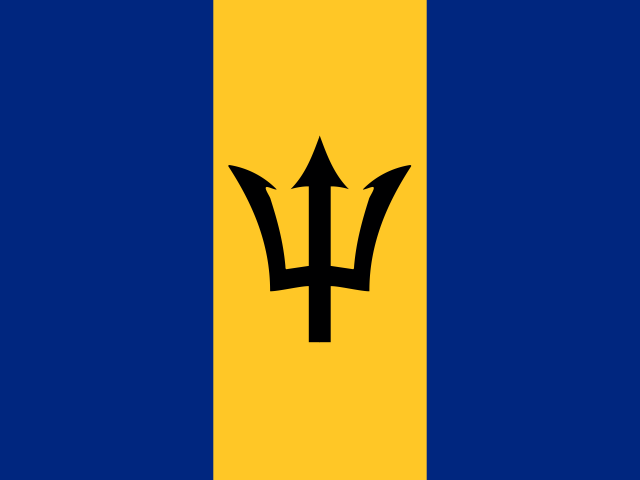
Barbados
Barbados is a relatively low, gently rolling eastern Caribbean island, geologically distinct from most of the volcanic Lesser Antilles. Much of the island has been extensively cultivated, with sugarcane fields, gardens and settlements covering the landscape, while the east coast is more rugged and exposed to the Atlantic. The interior is generally drier than the mountainous islands farther west, and natural habitats are concentrated in small pockets of woodland, wetlands and coastal vegetation. Scotland District in the northeast is the most rugged part of the island, with deeply eroded hills and gullies. Barbados is also one of the Caribbean's more developed and accessible islands, with a dense road network and extensive tourism infrastructure. Its position far out in the Atlantic gives it a distinctive maritime setting and makes it an occasional destination for naturally occurring vagrants.
Overview
Barbados is not a high-diversity birding destination, but its Atlantic position makes it interesting for migrants and vagrants, particularly after storms and during autumn migration. Chancery Lane Swamp is one of the island's most useful wetland sites, attracting herons, egrets, shorebirds and other waterbirds. Graeme Hall Nature Sanctuary, when accessible, has historically been an important wetland site close to the main tourist areas. The island's gardens, agricultural land and remaining woodland hold common Caribbean species, while Brown Trembler, Antillean Crested Hummingbird and Carib Grackle represent characteristic regional birds. Barbados is particularly convenient for independent birding because distances are short and roads are good. It is best approached as a compact Caribbean stopover for migrants, seabirds and regional species, rather than as a destination for a long endemic-focused birding trip.
Top 10 target species
| Species | Annual frequency | January | February | March | April | May | June | July | August | September | October | November | December |
|---|---|---|---|---|---|---|---|---|---|---|---|---|---|
| Zenaida Dove Zenaida aurita | 60.7% | 53.5% | 61.3% | 58.6% | 64.1% | 67.8% | 70.2% | 70.7% | 59.7% | 61.7% | 57.6% | 53.6% | 49.9% |
| Carib Grackle Quiscalus lugubris | 56.8% | 56.3% | 61.9% | 59.8% | 58.5% | 56.8% | 62.2% | 66.2% | 51.6% | 50.2% | 45.8% | 55.3% | 56.7% |
| Gray Kingbird Tyrannus dominicensis | 56.2% | 55.8% | 55.1% | 58.7% | 59.2% | 56.8% | 60.2% | 63.1% | 50.2% | 52.9% | 57.0% | 55.2% | 50.9% |
| Common Ground Dove Columbina passerina | 46.8% | 42.1% | 42.6% | 43.0% | 48.6% | 48.4% | 48.7% | 51.7% | 44.6% | 53.6% | 52.2% | 46.1% | 40.0% |
| Scaly-naped Pigeon Patagioenas squamosa | 46.1% | 31.0% | 33.5% | 40.7% | 48.2% | 54.7% | 59.9% | 63.8% | 53.9% | 54.0% | 47.9% | 37.2% | 28.9% |
| Western Cattle-Egret Ardea ibis | 44.7% | 44.5% | 41.3% | 43.7% | 46.8% | 42.8% | 46.1% | 49.0% | 42.2% | 46.5% | 46.2% | 46.6% | 40.5% |
| Barbados Bullfinch Loxigilla barbadensis | 44.0% | 46.1% | 53.7% | 52.8% | 52.2% | 46.3% | 48.1% | 44.8% | 30.3% | 26.4% | 35.4% | 47.4% | 44.7% |
| Eurasian Collared-Dove Streptopelia decaocto | 43.1% | 38.5% | 43.4% | 43.4% | 46.4% | 45.9% | 47.1% | 49.1% | 42.7% | 48.6% | 43.6% | 36.2% | 32.7% |
| Common Gallinule Gallinula galeata | 40.9% | 42.2% | 35.3% | 38.6% | 35.2% | 41.1% | 46.6% | 46.4% | 42.7% | 45.8% | 44.4% | 35.7% | 36.3% |
| Black-faced Grassquit Melanospiza bicolor | 39.4% | 37.8% | 38.4% | 37.2% | 43.3% | 43.9% | 42.8% | 50.5% | 35.8% | 34.1% | 34.9% | 38.0% | 35.6% |