
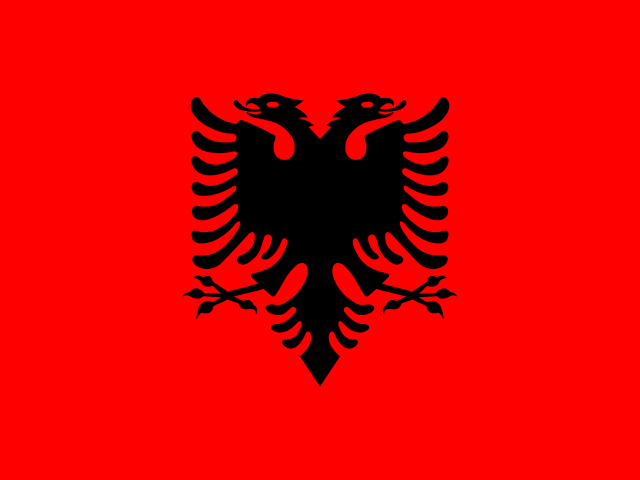
Albania
Albania is a predominantly mountainous Balkan country stretching from the Adriatic and Ionian coasts to the rugged interior ranges. The north is dominated by the dramatic Albanian Alps, while central and southern regions combine forested mountains, river valleys, karst landscapes and Mediterranean scrub. Coastal lowlands contain lagoons, wetlands, dunes and agricultural plains, including several important ecosystems along the Adriatic. The climate is Mediterranean near the coast, with hot, dry summers and mild winters, becoming cooler and more continental at higher elevations. Albania retains extensive relatively undeveloped mountain landscapes despite rapid development around major cities and parts of the coast.
Overview
Albania offers an attractive combination of Mediterranean, wetland and Balkan mountain birds. Coastal wetlands such as Divjakë-Karavasta National Park are especially important, with Dalmatian Pelican, Pygmy Cormorant, herons and numerous migrating waterbirds. Lake Shkodra and the lagoons around Narta provide additional productive wetland habitat. Mountain regions support Rock Partridge, Golden Eagle, Alpine Chough and other Balkan upland species, while Mediterranean scrub and farmland hold European Roller, European Bee-eater and various warblers. Albania's birding-tourism sector is still developing, but improving roads and widespread accommodation make many sites increasingly accessible. Remote mountain areas may require longer drives or local guidance. The country's appeal lies in combining important Adriatic wetlands with relatively wild Balkan mountain habitats.
Top 10 target species
| Species | Annual frequency | January | February | March | April | May | June | July | August | September | October | November | December |
|---|---|---|---|---|---|---|---|---|---|---|---|---|---|
| Hooded Crow Corvus cornix | 41.9% | 36.7% | 52.3% | 43.7% | 43.9% | 45.3% | 43.0% | 32.4% | 33.1% | 36.3% | 38.1% | 47.5% | 50.6% |
| House Sparrow Passer domesticus | 41.8% | 29.4% | 36.5% | 50.4% | 46.8% | 50.3% | 50.1% | 46.9% | 42.8% | 37.5% | 41.0% | 40.9% | 28.5% |
| Eurasian Magpie Pica pica | 40.5% | 49.8% | 56.4% | 55.0% | 33.8% | 32.8% | 32.6% | 19.5% | 27.0% | 32.1% | 40.2% | 56.4% | 50.6% |
| Eurasian Collared-Dove Streptopelia decaocto | 35.7% | 22.8% | 40.9% | 52.3% | 38.9% | 36.4% | 35.7% | 35.7% | 39.5% | 35.1% | 27.6% | 30.6% | 33.5% |
| Great Tit Parus major | 33.7% | 30.1% | 47.6% | 44.4% | 36.0% | 34.3% | 27.7% | 17.4% | 28.0% | 35.2% | 34.0% | 29.7% | 40.6% |
| Common Chaffinch Fringilla coelebs | 29.8% | 45.0% | 52.5% | 40.5% | 21.6% | 22.2% | 24.1% | 9.5% | 19.1% | 15.4% | 25.1% | 36.8% | 45.6% |
| Little Egret Egretta garzetta | 28.7% | 39.0% | 28.8% | 26.7% | 28.4% | 26.7% | 25.3% | 24.6% | 33.2% | 32.1% | 29.8% | 26.4% | 24.1% |
| Barn Swallow Hirundo rustica | 28.0% | 0.0% | 0.0% | 15.5% | 59.8% | 58.4% | 58.6% | 53.6% | 56.0% | 27.6% | 6.7% | 0.0% | 0.0% |
| Yellow-legged Gull Larus michahellis | 27.7% | 32.8% | 37.6% | 31.2% | 26.1% | 22.8% | 22.9% | 23.5% | 25.1% | 30.1% | 27.5% | 24.4% | 28.1% |
| Black-headed Gull Chroicocephalus ridibundus | 26.2% | 38.6% | 45.2% | 31.0% | 16.0% | 6.0% | 8.6% | 18.7% | 24.9% | 24.3% | 31.7% | 29.8% | 39.1% |