
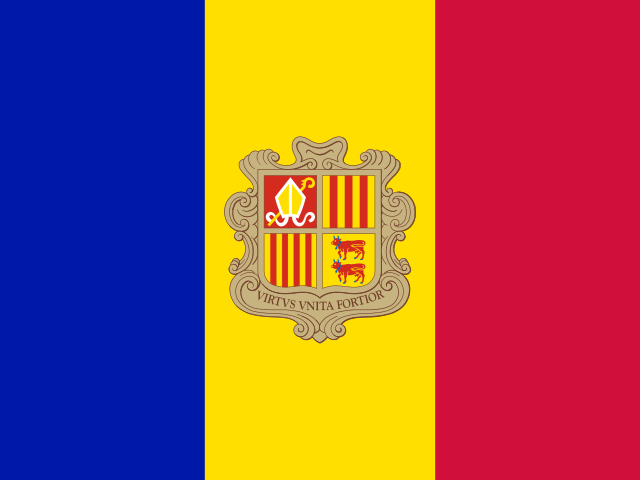
Andorra
Andorra is a tiny principality situated high in the Pyrenees between Spain and France. Almost the entire country is mountainous, with steep valleys, rocky peaks, alpine meadows and numerous glacial lakes. Lower slopes support deciduous woodland, giving way to extensive pine and fir forests and eventually open alpine habitats above the treeline. Elevations range from about 840 metres to nearly 3,000 metres, producing strong climatic differences over short distances. Winters are cold and snowy, while summers are generally mild, making the mountains popular for skiing and hiking.
Overview
Andorra is primarily a destination for Pyrenean mountain birds. High elevations support Lammergeier, Golden Eagle, Alpine Chough, Alpine Accentor and Water Pipit, while rocky slopes can produce Wallcreeper. Mountain forests hold Black Woodpecker, Crested Tit and Eurasian Nuthatch, with Citril Finch occurring around open conifer woodland. Areas such as Sorteny Valley and Madriu-Perafita-Claror provide particularly good access to varied mountain habitats. Andorra has little dedicated birding tourism, but excellent hiking infrastructure and its compact size make independent exploration straightforward. Many productive areas require walking at altitude, and snow restricts access to higher elevations outside the warmer months. Its main appeal is accessible high-Pyrenean birding concentrated within a very small area.
Top 10 target species
| Species | Annual frequency | January | February | March | April | May | June | July | August | September | October | November | December |
|---|---|---|---|---|---|---|---|---|---|---|---|---|---|
| Coal Tit Periparus ater | 42.6% | 38.3% | 47.0% | 43.0% | 53.1% | 57.2% | 50.9% | 47.9% | 41.8% | 35.7% | 39.1% | 37.8% | 18.9% |
| Common Chaffinch Fringilla coelebs | 40.1% | 44.1% | 26.8% | 40.4% | 47.3% | 45.6% | 47.1% | 46.4% | 26.0% | 16.5% | 36.8% | 61.3% | 43.5% |
| Eurasian Blackbird Turdus merula | 37.6% | 48.7% | 34.0% | 44.2% | 52.7% | 54.5% | 48.2% | 30.1% | 30.3% | 13.4% | 23.3% | 33.7% | 37.9% |
| Great Tit Parus major | 32.2% | 39.1% | 36.8% | 43.1% | 43.8% | 35.5% | 22.2% | 14.7% | 20.1% | 17.8% | 32.2% | 48.0% | 32.5% |
| Eurasian Crag-Martin Ptyonoprogne rupestris | 31.7% | 2.4% | 23.9% | 36.9% | 57.3% | 39.0% | 42.0% | 37.9% | 54.8% | 48.1% | 32.3% | 5.7% | 0.0% |
| European Robin Erithacus rubecula | 30.3% | 19.1% | 18.5% | 41.0% | 44.1% | 40.7% | 37.3% | 33.1% | 23.4% | 23.3% | 26.8% | 26.7% | 30.0% |
| House Sparrow Passer domesticus | 30.0% | 31.9% | 35.6% | 36.8% | 39.2% | 35.7% | 25.5% | 23.8% | 26.0% | 19.1% | 24.8% | 33.0% | 28.9% |
| Black Redstart Phoenicurus ochruros | 29.5% | 2.5% | 4.4% | 22.3% | 50.4% | 42.8% | 43.1% | 42.7% | 44.4% | 38.2% | 39.5% | 19.3% | 3.9% |
| White Wagtail Motacilla alba | 26.4% | 19.9% | 23.5% | 35.7% | 35.8% | 24.6% | 23.4% | 20.9% | 29.1% | 28.7% | 44.6% | 24.2% | 6.9% |
| Eurasian Griffon Gyps fulvus | 25.5% | 19.2% | 21.9% | 19.2% | 22.7% | 26.4% | 22.9% | 32.6% | 33.6% | 39.7% | 27.4% | 26.8% | 13.2% |